
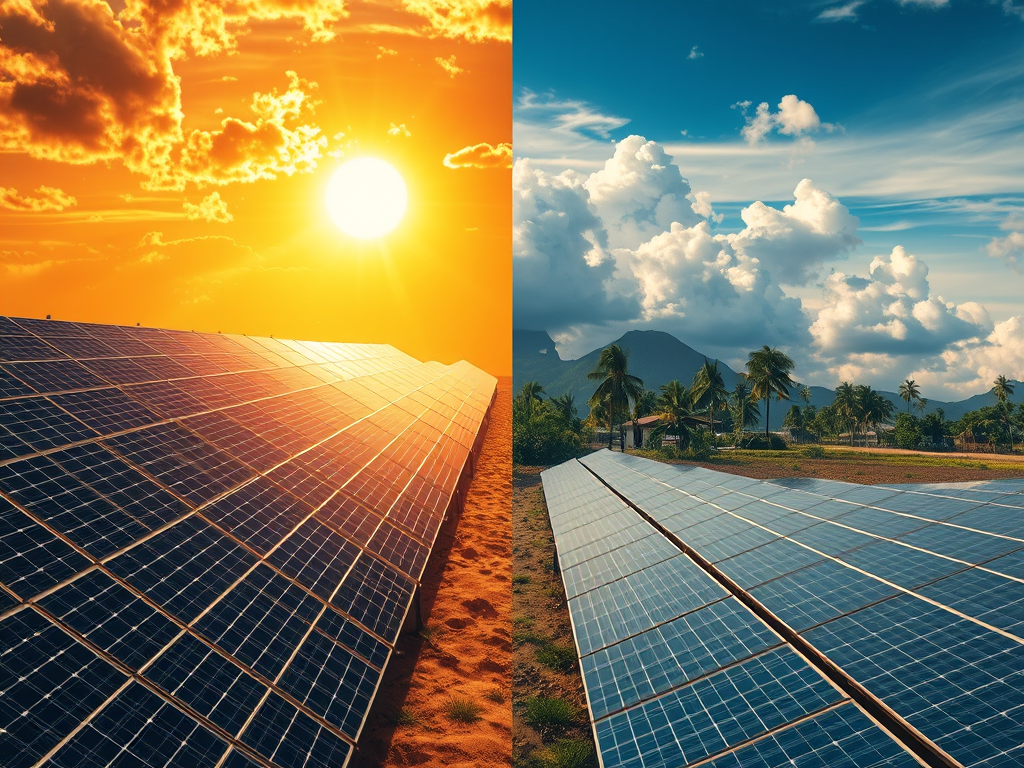
You would think the sun shines the same, regardless where. But when it comes to developing utility-scale solar projects, the differences between regions like Malaysia and Iberia (Spain & Portugal) can be stark; from capacity factors and total installation cost to permitting and returns.
Whether you’re an investor considering your next market, or a project developer looking to expand, here’s a high-level comparison to help frame your thinking.
☀️ Solar Resource & Capacity Factor
- Iberia
Spain and Portugal enjoy some of the best solar irradiance in Europe, with capacity factors typically between 18% and 22%, depending on location and technology (tracking vs fixed-tilt). Bifacial panels with single-axis tracking in southern Spain often push capacity factors beyond 21%, even up to 24%. - Malaysia
Despite being in the tropics, Malaysia’s solar yield is constrained by frequent cloud cover and high humidity. Capacity factors typically range between 14% and 16%, even with tracking systems. Fixed-tilt systems are still common due to cost and land constraints.
While technology selection has a material impact on capacity factor, frequent cloud cover and the monsoon season remain fundamental disadvantages limiting Malaysia’s solar output.
💰 Installation Cost (CAPEX) and Levelised Cost of Electricity (LCOE)
- Iberia
Competitive EPC market and economies of scale keep total installed cost low, ranging between €500 to €1,000 per kW (US$600 to US$1,200 per kW). Access to European manufacturing and logistics reduces BOS costs. Grid connection costs, however, can vary widely depending on substation proximity and regional network constraints. - Malaysia
While local EPC costs are relatively lower, supply chain dependency on imported modules, inverters, and structures exposes projects to FX and shipping volatility. Total installed cost for utility scale solar in Malaysia ranges between RM3,000 to RM4,500 per kW (US$750 to US$1,125 per kW). Weak grid infrastructure in rural areas can further inflate connection costs.
While nominal CAPEX in Malaysia is similar if not potentially lower than Iberia, the former’s lower solar capacity factor will result in higher unit cost. On a $/kWh basis when adjusted for output, LCOE in Malaysia is higher (US$40 to US$60 per MW) compared to Iberia (US$35 to US$50 per MW).
🏛️ Regulatory Compliance & Permitting
- Iberia
Spain and Portugal have made major strides in simplifying permitting, but the process remains highly procedural and varies by region.
Environmental Impact Assessments (EIA), grid access guarantees, and zoning approvals can stretch over 18–36 months.
Developers often face grid saturation and speculative congestion. - Malaysia
The process is more centralised via the Energy Commission (ST) and SEDA, but strict quota systems (e.g. under Large Scale Solar, LSS schemes) mean success is tied to auction cycles.
Permits include EIA, land conversion, local authority approvals, and interconnection studies. While still complex, the process is often less fragmented than in Europe, with typical zoning approvals taking 12–24 months.
In short, Malaysia is more centralised and policy-driven; Iberia is more open but risks grid bottlenecks and regional hurdles.
💰 Subsidies & Revenue Model
- Iberia
The subsidy era has ended. New projects rely heavily on merchant pricing, corporate PPAs, or capacity auctions. Spain’s spot prices can be volatile due to cannibalisation effects, though long-term PPAs (>10 years) with corporate offtakers are now the main hedge. Portugal continues to run renewable auctions, but recent volumes have been limited. - Malaysia
Malaysia still relies on regulated offtake under the Large Scale Solar (LSS) programme, where government-set tariff via competitive bidding. Tariffs awarded are locked for 21 years, offering long-term revenue certainty but lower upside.
For commercial & industrial (C&I) segments, Net Energy Metering (NEM) allows rooftop developers to offset demand at retail tariffs.
In short, Malaysia offers stable, regulated returns; Iberia provides market upside (and risk) via merchant exposure or corporate PPA.
📈 Returns & Risk Profile
Project returns vary widely depending on the project complexity and how the offtake is structured. Fully contracted PPAs with capped tariffs generally yield steadier, lower unlevered IRRs (7-9%), while projects with partial merchant exposure or more flexible pricing structures can achieve higher returns (IRRs in the 12–15% range), though at the cost of higher risk and lower bankability.
Final Thought
Developing solar in Iberia and Malaysia both offer compelling opportunities, but the approach, expectations, and risks are fundamentally different.
- Iberia is a mature, liberalised market for developers who can navigate permitting risk and ride the merchant/price/PPA waves.
- Malaysia offers more certainty, but success is tied to auction cycles, local partnerships, and navigating government frameworks.
A good project is more than just sunshine. It’s about navigating regulation, structuring returns, and securing offtake that makes sense for your capital.
If you’re weighing where to develop or invest next, understanding the nuances behind the numbers is key.
 Makna Advisory
Leave a comment