
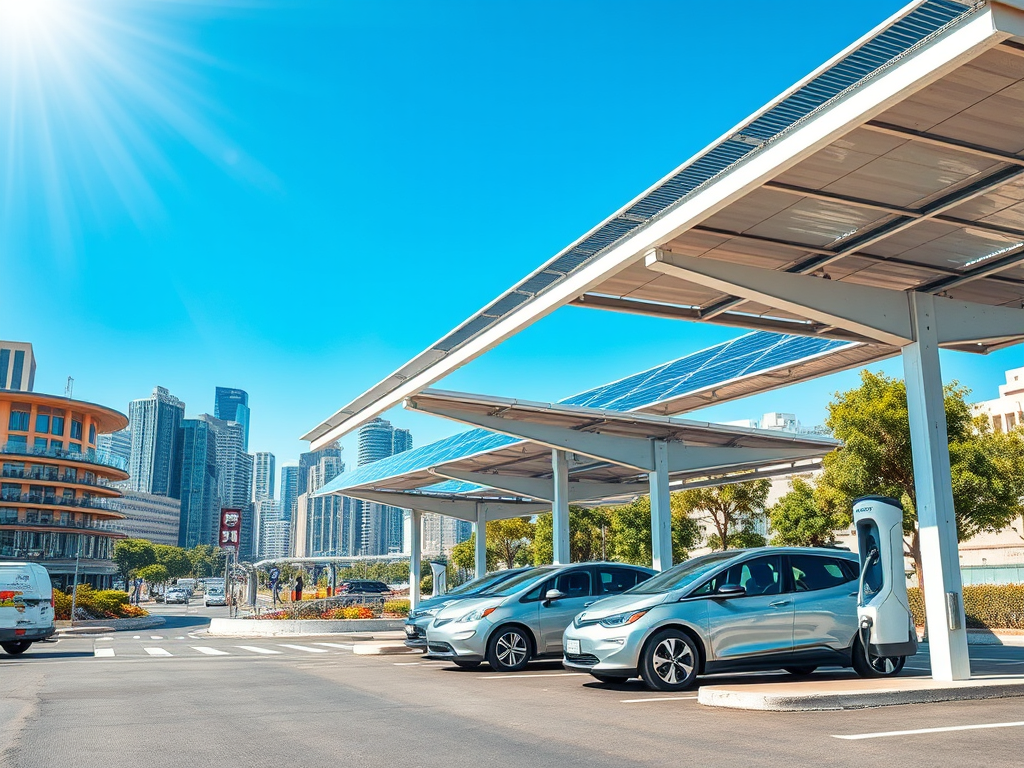
I recently spoke with a start-up founder working on an integrated solution combining solar carports with EV charging. It’s not a new idea. Fastned, the Dutch-listed high-power charging company, has built a growing European network where most stations feature solar-panel roofs.
But the more I researched, the clearer it became. This hybrid model isn’t just logical, it’s necessary.
The Terrible Twos: The Two Paint Points
As Europe pushes to accelerate the energy transition, two major bottlenecks keep surfacing.
Land scarcity: One of the biggest arguments against renewables energy is its land footprint. Whether solar farms or wind parks, they require vast areas. France has already announced a target to halve new land artificialisation by 2031 and to halt it completely by 2050. The message is clear — We cannot keep expanding by taking up new land. We need to use existing urban surfaces more efficiently.
Undeveloped EV charging infrastructure: EV adoption is surging, but charging infrastructure still lags behind. The biggest challenge is not just installing chargers. It is making them economically viable. With uncertain utilisation rates, many stations sit idle for long periods, leaving investors questioning the payback.
Taken separately, these two problems slow down progress. But when you put them together, the weaknesses start to look like strengths. Pairing solar carports with EV charging doesn’t just solve land scarcity and underutilisation. It creates a stronger, more integrated business case.
Solar Carports: Land-Efficient Solar Adoption
Ground-mounted utility-scale solar projects often faces pushback for competing with agriculture or other land uses.
Solar carports solve this by using already-developed spaces, e.g. parking lots. In France, legislation now requires parking areas larger than 500m² to be covered with solar panels. This not only accelerates adoption but also avoids the “land cannibalisation” issue.
However, if a carpark owner installs PV just to sell excess power back to the grid at regulated wholesale rates (say around €90/MWh), the economics are limited. The returns simply don’t justify the upfront investment.
EV Charging: Infrastructure in need for Utilisation Certainty
EV adoption is accelerating, but charging infrastructure is still a bottleneck. Both governments and private investors are under pressure to fund charging stations.
However, EV charging is capital-intensive, and uncertain utilisation rates undermine bankability.
Targeting high-traffic locations such as malls or retail parks makes sense, but landlords are often reluctant to commit space without charging a premium “rent”.
The Perfect Match: Solar + EV Charging
Here’s where the two solutions complement each other,
- Higher revenue per kWh: Selling solar power directly into EV charging can capture much higher prices than wholesale export. Instead of €90/MWh selling back to the grid, retail charging rates often range from €250 to €400/MWh (25–40 cents per kWh).
- Better utilisation: Retail parks, supermarkets, and offices, the sites most impacted by the carport mandate, already attract steady customer footfall. EV chargers here are more likely to be used, while also boosting store traffic.
- Grid benefits: On-site generation and consumption reduce stress on local grids, especially during peak demand.
Hourly Matching & Price Arbitrage: The Non-Devil in the Details
Perhaps the biggest value proposition in this hybrid arrangement is price arbitrage.
Looking at solar and EV charging separately highlights their weaknesses. Together, however, they unlock a more dynamic value proposition.
- EV charging only: Margins are squeezed by the cost of buying electricity from the grid. In France, considering regulated commercial tariffs, margins are in the range of €100-150/MWh. Profitability depends heavily on utilisation, and the electricity may not be 100% green.
- Solar carport only: Peak midday solar production often coincides with oversupply in the grid, pushing spot prices down. In these hours, it can actually be cheaper for the owner to buy electricity from the grid at low (or sometimes even negative) prices than to generate their own. On top of that, exporting excess solar without a Feed-in Tariff (FiT) is rarely profitable, as wholesale prices seldom cover the investment cost.
- Solar + EV charging combined: Here’s the sweet spot. When solar generation peaks around noon, it should coincide naturally with higher on-site activity in places like supermarkets, offices, or retail parks, when many cars are already parked. Instead of dumping cheap power to the grid, that electricity can be channelled into EVs on-site at retail charging rates. The result is a built-in hedge: low-cost generation meets high-value consumption.
This alignment of generation and demand creates resilience against wholesale market swings and strengthens the business case.
The Big Picture
On their own, solar carports risk being uneconomic, while EV charging stations risk being underutilised. But together, they can create a sustainable and profitable ecosystem,
- Solar improves the economics of EV charging by reducing input costs.
- EV charging improves the economics of solar carports by enabling high-value self-consumption.
This isn’t theory. France’s solar carport mandate and the EU’s drive for EV infrastructure are already shaping the conditions for this synergy to scale.
The conclusion is simple. The future of EV charging and distributed solar may be found in the same car park.
 Makna Advisory
Leave a comment